
Save Sparrows in Our Cities Simple Ways to Protect Urban Birds

A sparrow used to be part of the everyday sound of a home. Its chirping came from balconies, courtyards, tea stalls, school walls, and small gardens. Today, in many cities, that familiar sound has become rare.
The house sparrow has not vanished everywhere, but its decline in urban spaces is real enough for people to notice. Older residents often remember flocks gathering near grain shops or nesting in roof gaps. Children in high-rise apartments may see pigeons every day, but not a single sparrow for weeks.
This change is not just about one small bird. Sparrows are part of the urban ecosystem. They feed on grains, seeds, and insects. They nest close to human homes. They remind us that a city is not only made of roads, towers, and traffic. A healthy city must also have shade, soil, water, insects, and safe spaces for other living beings.

Why sparrows are disappearing from city life
The question many people ask is शहरों में गौरैया क्यों कम हो रही हैं? The answer is not one single cause. It is a mix of changes in how cities are built, how people live, and how much natural support birds can still find around them.
Sparrows thrive where three things are easy to find:
Small gaps for nesting
Food such as grains, seeds, and insects
Clean water and safe resting places
Modern cities often remove all three.
Urban buildings leave fewer nesting spaces
Old houses had tiled roofs, wooden beams, ventilators, wall cracks, open eaves, and small cavities. Sparrows used these spaces to build nests. They did not need forests or large trees. Human homes worked well for them.
New buildings are more sealed. Glass, concrete, smooth walls, metal cladding, and closed facades leave fewer corners where a small bird can safely nest. High-rise apartments may look clean and efficient, but for sparrows they can be almost unusable.
Air conditioners, false ceilings, covered vents, and netted balconies also reduce access. Many people block every gap to avoid dust or pigeons. In the process, sparrows lose the tiny safe places they once depended on.
Food has become harder to find
Sparrows eat grains and seeds, but young chicks need protein-rich insects. This matters a great deal. Adult sparrows may survive on crumbs or scattered grain, but chicks need soft insects in their early days.
Urban insect life has declined in many neighborhoods because of:
Excessive pesticide use in gardens and parks
Fewer native plants
Less open soil
Cleaner but less bird-friendly food storage
Loss of small farms and grain markets near homes
Earlier, grain shops, cattle sheds, home courtyards, kitchen gardens, and roadside vegetation supported sparrows. Today, packaged food, sealed storage, and paved land leave fewer feeding chances.
Water sources are disappearing
A sparrow does not need a pond. A shallow bowl, a dripping tap, or a small puddle can help. Yet cities drain water quickly. Open wells are covered, courtyards are paved, and summer heat dries small water sources fast.
During hot months, lack of water can become a serious stress for urban birds. Sparrows need water for drinking and bathing. Bathing helps keep feathers clean and healthy. Without water, survival becomes harder, especially for chicks and adults during breeding season.
Green cover is often decorative, not useful
A city may have ornamental plants, lawns, and trimmed hedges, but sparrows need living layers. They need shrubs, grasses, seed-bearing plants, and insect-friendly vegetation. A row of exotic palms may look neat, but it offers little food or shelter.
Native plants are far more useful. They attract local insects, provide seeds, and create safe cover from predators. When every wild patch is cut, sprayed, or paved, sparrows lose both food and protection.
Pollution and traffic add pressure
Noise, air pollution, vehicle movement, and intense lighting can disturb birds. Sparrows are adaptable, but constant disturbance affects feeding, nesting, and breeding behavior. Glass windows and reflective surfaces may also confuse birds and lead to collisions.
Some people blame mobile towers alone for the decline of sparrows. Scientific discussions on this topic are complex, and the evidence is not as simple as popular claims suggest. What is clearer is that habitat loss, food shortage, lack of nesting spaces, pesticides, and water scarcity form a strong and visible pattern.
What studies tell us about urban and rural sparrows
The Wildlife Institute of India has been associated with studies and monitoring efforts that compare bird populations across different habitats, including urban and rural areas. Such work has helped draw attention to a clear pattern: sparrows tend to do better where nesting sites, insects, grain, and vegetation remain available.
Rural and semi-rural areas often still provide many of these supports. Houses may have open eaves, cattle sheds, grain storage areas, hedges, fields, and mixed vegetation. These features create feeding and nesting opportunities.
By contrast, dense urban areas often have sealed architecture, heavy traffic, lower insect availability, and fewer safe nesting sites. Even when sparrows exist in cities, their numbers may be patchy. They may be present in older neighborhoods, markets, railway colonies, urban villages, or areas with gardens, while being rare in newer concrete zones.
This comparison teaches an important lesson. Sparrows do not need luxury conservation projects to return. They need basic habitat features to be restored.
A sparrow-friendly city is not a city with less development. It is a city that leaves room for life between its buildings.

Simple steps that can help sparrows survive
Sparrow conservation can start from a balcony, terrace, school, shopfront, temple courtyard, community park, or apartment society. The steps are simple, low-cost, and practical.
Install a sparrow house
A sparrow house gives birds a safe place to nest when buildings no longer offer natural gaps. Place it on a shaded wall, balcony, tree, or quiet corner where cats and other predators cannot reach easily.
A good sparrow house should have:
A small entrance suitable for sparrows
Protection from direct rain and harsh afternoon sun
Enough height from the ground
A quiet location away from constant human touch
No paint or chemical smell inside
Once installed, do not keep opening it to check for eggs or chicks. Birds need privacy. If sparrows accept the box, let them use it without disturbance.
Keep a shallow bowl of water
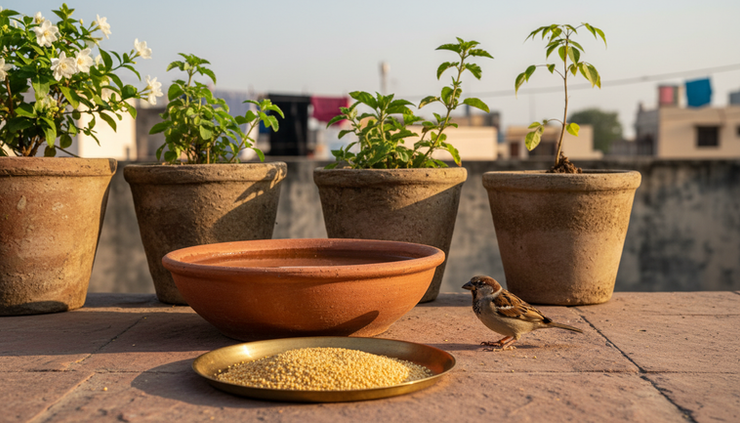
A simple water bowl can save birds during summer. Use a shallow earthen, ceramic, or metal bowl. Keep it in shade so the water does not heat up quickly.
Change the water every day. This prevents mosquitoes and keeps it clean. Place a small stone inside the bowl so tiny birds can stand safely while drinking.
This small act captures the spirit of एक छोटा सा घर, एक कटोरी पानी और हमारी बड़ी जिम्मेदारी. It reminds us that conservation does not always begin with large campaigns. It can begin with one careful daily habit.
Offer safe grain and seeds
Sparrows eat small grains such as millet, rice grains, wheat, and broken cereals. Put out a modest amount in a clean tray or feeder. Avoid salty, oily, spicy, or processed food.
Do not overfeed. Too much food can attract rats or create hygiene issues. A small regular supply is better than a large pile.
Also, keep the feeding area clean. Wash trays often. If food becomes wet or moldy, remove it.
Grow more greenery
Balconies, terraces, schools, and housing societies can all support sparrows by growing bird-friendly plants. Native shrubs, grasses, seed-bearing plants, and small trees help insects return. Insects help sparrow chicks survive.
Good choices include local flowering plants, grasses, herbs, and shrubs that suit the climate of the region. Even a few pots can make a difference if many households take part.
Avoid spraying pesticides. If pests appear, use safer methods such as hand removal, neem-based preparations, compost health, and plant diversity. A garden with a few insects is not a failed garden. It is a living garden.
Leave safe nesting corners
Not every corner of a home needs to be sealed. If a space is safe and does not create a hygiene problem, leave some small gaps for birds. In older homes, sparrows may use roof edges, ventilator spaces, or wall cavities.
Apartment societies can plan bird-friendly areas during renovation. Schools can create sparrow corners with nest boxes, water bowls, and native plants. Shops and community buildings can also place nest boxes under shaded ledges.
The goal is not to make homes messy. The goal is to make them kinder.
How communities can bring sparrows back
One home can help a few birds. A neighborhood can help many.
Sparrows move through shared spaces. They use terraces, trees, market lanes, school compounds, gardens, and open plots. This means community action matters.
Apartment residents can start with a small bird-care plan:
Place water bowls in shaded common areas
Install sparrow houses in quiet corners
Add native plants to gardens and boundary walls
Reduce chemical sprays
Keep some low shrubs instead of only lawns
Teach children to observe birds without chasing them
Clean feeders and bowls regularly
Schools can play a strong role. A school sparrow project can include nest box making, bird counts, water bowl care, and lessons on urban ecology. Children who learn to notice sparrows also learn to notice trees, insects, seasons, and water.
Local shops can help too. Grain sellers, tea stalls, and small markets have long been linked with sparrows. A clean feeder and water bowl near such places can support birds without causing waste.
City planners also have a role. Parks should include native shrubs and grasses, not only decorative lawns. Building rules can encourage bird-safe design. Public awareness can reduce the use of harmful pesticides. Urban biodiversity should not be treated as decoration. It is part of public health, climate comfort, and quality of life.
The role of Shivanta Foundation and shared responsibility
Shivanta Foundation’s nature-focused initiatives place emphasis on a simple but powerful idea: protecting nature is a collective responsibility. Sparrows are a perfect example of this idea because their survival depends on thousands of small choices made by ordinary people.
A foundation, school, resident group, or volunteer network can spread awareness. They can distribute sparrow houses, encourage water bowl drives, support plantation efforts, and guide communities on safe feeding practices. Yet the long-term success depends on daily care.
A nest box fixed and forgotten may not be enough. A water bowl left dry helps no bird. A garden sprayed with chemicals may look green but offer little life. Conservation works when people return to the habit of care.
Shivanta Foundation’s approach matters because it connects sparrow protection with a wider ethic. If people learn to protect sparrows, they also begin to think about trees, butterflies, bees, soil, and water. That shift in thinking can change a city.
Mistakes to avoid while helping sparrows
Good intentions need good practice. Some common mistakes can reduce the benefit or even harm birds.
Do not place nest boxes in direct sun. Heat can make them unsafe. Choose shade and airflow.
Do not use sticky traps, glue, or chemical repellents near feeding or nesting areas. These can harm birds and insects.
Do not feed bread, fried snacks, chips, biscuits, or spicy leftovers. These foods are not suitable for sparrows.
Do not keep water bowls dirty. Stale water can spread disease and attract mosquitoes.
Do not disturb nests once birds begin using them. Watching from a distance is enough.
Do not remove all shrubs in the name of cleanliness. Birds need cover. A perfectly bare garden is often a poor habitat.
A sparrow-friendly city is possible
The return of sparrows does not require every person to become a wildlife expert. It requires attention. It requires small changes repeated across many homes and neighborhoods.
Imagine a city where balconies hold water bowls, terraces grow native plants, schools maintain nest boxes, parks avoid excessive pesticides, and buildings leave safe spaces for small birds. Such a city would be cooler, kinder, and more alive.
The sparrow is small, but the lesson is large. When a city loses its smallest neighbors, it loses part of its own health. When it makes room for them again, it becomes more livable for everyone.

What to do today
Start with one step. Put out a clean bowl of water. Add a small feeder. Plant one native shrub. Install one sparrow house in a safe shaded place. Speak to a school, shop, or apartment association about doing the same.
If enough people take these small steps, cities can once again hear the chirping that once belonged to every morning.
Saving sparrows is not only about protecting a bird. It is about choosing what kind of city we want to live in.


Comments